

Growth and yield of forest plantations
Leader : David Pothier, Department of Wood of Forest Sciences, Université Laval
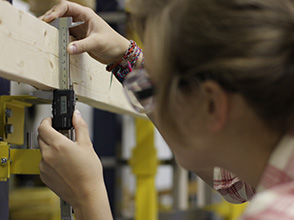
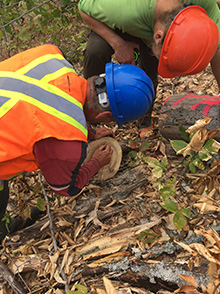
The regular spacing between the plants and the absence of gaps are causes of the high productivity of plantations in forest environment. However, this productivity could also be increased by occupying more of the vertical space under the dominant canopy, which would increase the interception of available light and the biomass produced per hectare. Better occupation of this vertical space could be achieved in mixed plantations taking advantage of complementary functional traits among species by planting, for example, a shade-tolerant species under a fast-growing shade-intolerant species. Increased productivity can also be achieved in plantations located near urban centers where fertilizing residual materials, of municipal or industrial origin, can be used to amend the soil of the plantations. As well, an adequate regime of intermediate cuts (thinning) could increase the production of large trees to allow their transformation into desired products. The establishment of fast-growing plantations, through short rotation coppice crops, is an interesting avenue to meet growing energy needs. However, the potential gains in productivity will vary not only according to the species planted and silvicultural treatments, but also according to soil and climatic conditions. Thus, the assessement of these gains must be carried out by a model that is flexible enough to take into account the effects of different silvicultural treatments while forecasting the growth of plantations established under conditions, never tested before. For this reason, research priorities on plantation growth and yield are articulated in four areas: (1) the production of mixed plantations, (2) the quantification of growth gains following fertilization, (3) the determination of thinning regimes based on species and management objectives, (4) the bioenergy yield of short-rotation coppice, and (5) the development of a semi-functional model to predict the production of plantations under various conditions.
Ecological restoration of disturbed/anthropized sites
Leader : Marie Guittonny, The Research Institute on Mines and Environment (RIME)- Université du Québec en Abitibi-Témiscamingue
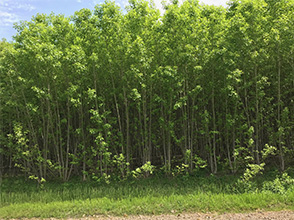
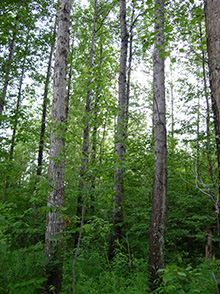
Because of the transformation of land for human use, 60% of ecosystem services would already be degraded. More and more researchers are interested in the services associated with the world’s forest ecosystems. For example, the woody biomass produced by these ecosystems is worth US$400 billion annually and their soils store up to 45% of terrestrial carbon. In Quebec, there are thousands of disturbed and anthropized sites, such as bare forest land (e.g. poorly regenerated burns), highly mineralized urban sites (industrial wastelands, highway and railway rights-of-way, etc.), former mines and sandpits, and agricultural wastelands. These sites are often abandoned, unproductive, and non non adequately used, and they provide few or no ecosystem services or create environmental complications. Ecological restoration of these sites would reintegrate them into the natural landscape and restore ecological goods and services destroyed by human activities. To restore a forest ecosystem, the re-establishment of trees as dominant species is essential to restore the main energy flows and a three-dimensional structure that supports other organisms. In most cases, these sites have physical, chemical and biological limitations to tree regeneration of tree cover. Propagule sources of tree species can be limited on disturbed and anthropized sites, and it is often necessary to introduce trees by planting. The development of native tree lines adapted to the specific constraints of revegetation on disturbed and anthropized sites, such as poorly aerated soils or soils with high salinity, is necessary to reforest these areas. When these plants are inoculated with appropriate symbiotic microorganisms, their establishment can be improved, but much work remains to be done to identify these microorganisms. The abiotic stresses of the soils can also be reduced by using organic amendments or topsoil, but the doses, thicknesses and materials remain to be specified to optimize the success of reforestation. To reduce abiotic constraints, plantations of fast-growing pioneer species can be used as shelter planting to facilitate forest plant succession and the restoration of associated ecosystem services.
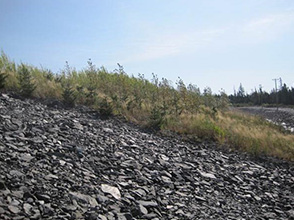
Three years plantation of hybrid poplar and jack pine de pins gris on soils covering slopes of sterile rocks left generated by mining activity
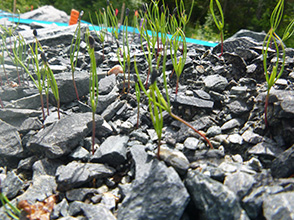
Seedlings of jack pineson mining sterile rocks.
Photos : Marie Guittonny, UQAT
Resilience plantations
Leader : Alain Paquette, Department of biological sciences, Université du Québec à Montréal
At the global level, plantations are generally perceived as “biological deserts” that do not provide adequate habitat for plant and animal biodiversity. Concerns regarding the maintenance of biodiversity are particularly strong in Quebec, as plantation, especially intensive, is a recent silvicultural activity, and its effects on biodiversity are not yet well documented. This poor perception of plantations is nevertheless being questioned. Indeed, although the establishment of plantations to replace natural forests often causes a loss of biodiversity, several studies have shown that it is evitable and that plantations can host flora and fauna, similar to those found in natural forest stands, especially when an adequate comparison is used, for example a forest regenerated after cutting of the same age as the plantation. In fact, it is much more the harvesting itself that causes the modifications to the habitat, rather than the planting. However the practices related to the latter (site preparation, their arrangement in time and space, maintenance and diversification) can be improved in order to increase the quality of habitats and their resilience. Given the variability in the quality of habitats generated by plantations, it is essential to determine the factors (e.g. composition, structure and area of the plantation, type of cover prior to planting) that allow biodiversity to be maintained in these stands. Beyond the internal factors, the size, location and spatial arrangement of plantations on the landscape must also be considered so that the forest matrix remains functional for the wildlife species that inhabit it. So far, we have a very limited understanding of the effect of the landscape context of plantations on plant and animal biodiversity. Thus, the objective will be to characterize the effects of plantations on plant, animal and microbial biodiversity and related functions (e.g. litter degradation and recycling of elements at stand and landscape scale), as well as to determine the characteristics of the planted stands (vegetation composition and structure) and of the surrounding landscape associated to these effects. The new knowledge acquired can be used by forest managers to improve the establishment of plantations and ultimately to maintain forest biodiversity as well as the resilience of stands and the maintenance of related functions.
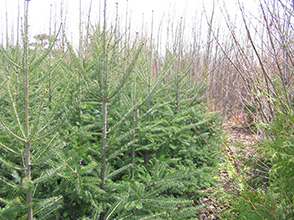
Experimental plantation on biodiversity in Sainte-Anne-de-Bellevue
Photo : Alain Paquette, UQAM
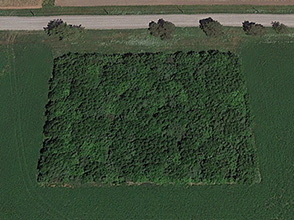
Aerial photo of the plantation of Sainte-Anne-de-Bellevue
Source : Google Earth
Phytoremediation and production of biosourced products
Leader : Michel Labrecque, Institut de recherche en biologie végétale, Université de Montréal
Contaminated soil in urban and peri-urban areas is a growing environmental problem in Quebec and around the world. In North America, there are more than 650,000 contaminated sites that could be rehabilitated. There are countless technical solutions for the rehabilitation of contaminated soil. Among the “soft” techniques, phytoremediation – the use of plants to decontaminate soil – is an effective, low-cost approach that is part of a sustainable development context. Planting fast-growing tree species, particularly willows or poplars, is a proven solution for gradually rehabilitating these disturbed or anthropized sites, or simply to better develop these abondoned lands. Under these conditions, it is possible to obtain appreciable yields of lignocellulosic biomass that can be used for energy purposes. But more than that, recent work has shown that plants exposed to environmental stress (contamination) can respond by developing defense molecules in their metabolism and that these metabolites (terpenoids, triglycerides, tannins, etc.) can be exploited to produce a range of value-added products (bioproducts) that are increasingly sought after (bioplastics, bioflocculants, etc.). By combining phytoremediation with the production of biomass, and consequently of biosourced products, it is possible to implement circular economy systems that make phytoremediation technology even more attractive. Phytoremediation could therefore be one of the driving forces of such a circular economy by stimulating viable chains in the green chemistry sector while allowing the development of socially acceptable and ecologically sustainable economic activities.
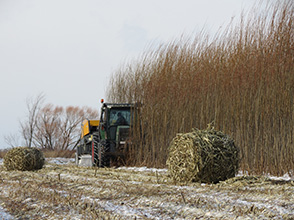
The harvest of willow biomass using a Biobaler on a contaminated site in Varennes
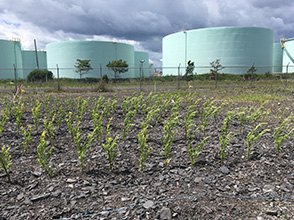
Phytoremediation of contaminated soils in eastern Montreal. The trial include several varieties of willow and poplar
Photos : Michel Labrecque, Université de Montréal
Genetic improvement and adaptation
Leader : Martin Perron, Forest Research Branch, Ministry of Forests, Wildlife and Parks of Quebec
Ovver the past 20 years, the annually reforested area in Quebec represents 75 000 hectares and silvicultural investments of more than $200 million per year. It takes about 50 years for the best sites to achieve maximum productivity of quality wood. With global changes, trees will have to adapt to climatic extremes and will be more than ever exposed to numerous environmental stresses, such as water stress and pest attacks. Therefore, it becomes imperative to wisely choose the parents producing the seeds for reforestation, in order to ensure the adaptation and resilience of trees, and to have healthy and productive plantations. The adaptation and resilience of trees depends on genetic diversity within species and populations. Today, advances in ‘omics’ science, high-throughput phenotyping for complex traits (e.g. drought tolerance) and other disciplines in forest genetics, as well as tree populations in comparative plantations for major commercial forest species, provide a unique opportunity for a rational selection of parents. Thus, it is possible to characterize genetic traits related to resistance to environmental stresses and wood properties for thousands of seed trees. With the monitoring of multi-site comparative plantations, including various genetic elements (provenance, progeny, clone) and climatic predictors (aridity index, mean annual temperature, etc.), it will also be possible to model the response of productivity and environmental resilience to current or future climatic conditions.
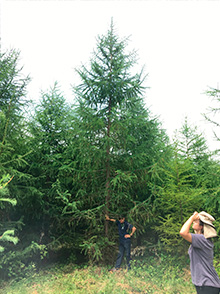
An 8 years hybrid larch of the new generation (July 2019).
Photo Pier-Luc Faucher, MFFP.
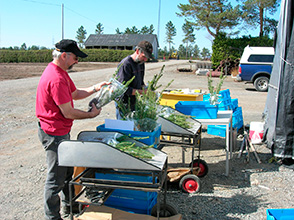
Permutation of white spruce seedlings by family for a genetic test in the forest nursery of Saint-Modeste.
Photo Guildo Gagnon, MFFP.
Valorization of fertilizing residual materials and carbon sequestration
Leader: Rock Ouimet, Forest Research Branch, Ministry of Forests, Wildlife and Parks of Quebec
The use of fertilizing residual materials (FRMs) (e.g. municipal sludge, lime sludge and ashes) in agriculture is now widespread. Its beneficial effects on crop yields are recognized and the risks to ecosystem and human health are low if applied properly. It is also an efficient way to dispose of residues that would otherwise be disposed of in landfills or incinerated. In this sense, Quebec’s waste management policy aims to ensure that municipalities and industries recycle all the organic waste they generate by 2020. Quebec’s forest industry is beginning to use MRFs to increase soil fertility, tree nutrition and plantation yields in general. The spreading of FRMs would also promote carbon sequestration in soils. The valorization of FRMs is an interesting alternative in intensive silviculture, notably because it has the potential to increase tree yields and avoids burying or incinerating organic matter, which respects the 3RV-E hierarchy of the Quebec Residual Materials Management Policy. As part of multiple projects, the network team is implementing a major program to monitor soil, foliar nutrition and the growth of several plantations in Quebec. The studied sites are fertilized at different rates with FRMs, either in combination or separately. In some cases, a second fertilization is done 3 to 5 years after the first fertilization. The objectives are to specify the types of FRMs, dosages and application schedules that are optimal for tree nutrition and growth, and to develop a fertilization program on all the areas being harvested according to the characteristics of the sites (precision forestry). Particular attention is paid to the effects of fertilization on the carbon budget. The team is also working with the researchers involved in QNRIS theme #2 to establish alders, willows, poplars, larches and spruces on soils, reconstructed (technosoils) from FRMs. Soil reconstruction is done with a mixture of de-inking and municipal sludge, which stabilizes the mining dumps and balances nutrient availability. The use of FRMs is an appropriate mean of accelerating the positive effects of phytoremediation by rapidly restoring soil functions that are favourable to the establishment of perennial plants.
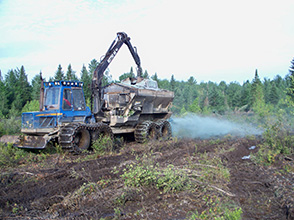
Spreading lime sludge before planting in Estrie
Photo : Nicolas Bélanger, Université TÉLUQ
Wood processing and value chain
Leader: Alexis Achim, Department of Wood and Forest Sciences, Université Laval
The development of an intensive silviculture approach that focuses primarily on planting will inevitably change the characteristics of wood processing plant supplies. However, since the beginning of the industrial era, Quebec processing plants have always been able to rely on the harvesting of old and slow-growing natural forests, which gives the material advantageous physical and mechanical properties. The anticipated change in these properties and the associated loss of an asset that allows our products to stand out internationally are among the elements that prevent forest managers from putting forward dynamic silvicultural strategies based on rapid growth and short rotations. However, such strategies could also have positive effects on the wood value chain. One of the factors limiting the yield of primary processing plants is the small size of the stems harvested in the northern part of the productive forest territory, where the majority of our natural mature forests are now located. The production of larger stems would have the advantage of significantly increasing the proportion of sawn lumber, and thus decreasing the proportion of lower-value co-products such as chips. In this context, the priorities in this field of research will be to : (1) define optimized silvicultural scenarios that permits the achievement of acceptable stem dimensions for the primary transformation process without unduly affecting wood quality, (2) characterize the growth and wood properties of trees resulting from genetic improvement programs in order to identify the individuals and families offering the best balance between growth rate and the maintenance of acceptable wood properties, (3) integrate the wood harvesting and transformation processes into models for evaluating the financial and economic returns associated with various planting strategies.